top of page
Odak Noktasındaki Cerrah

SKIN TUMORS

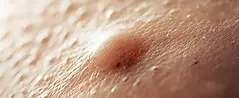
Skin tumors are defined as any lesion, present from birth or acquired, anywhere on the body, that is skin-colored or of a different color, located at or below the skin's surface, or originating from the skin and its appendages.

SKIN TUMOR SYMPTOMS

  • Newly appearing or noticed spots/bumps/lumps

    • Growth: A gradual increase in size.

    • Change: The alteration of shape, color, texture, or border over time.

    • Irregular edges: Blurred, jagged, or asymmetrical appearance.

    • Color variety: Multiple color tones in the same area (brown, black, red, blue-gray, whitish)

  • Persistent crusting/bleeding: Spontaneous bleeding or easy bleeding.

  • Wound -like appearance: A wound that doesn't heal and lasts longer than 3-4 weeks.

  • Leakage/ discharge: Local discharge, wetness, deteriorating crust.

  • Itching, burning, or pain: Especially newly appearing and persistent symptoms.

  • Thickening/hardening : Noticeable hardness or elevation upon touch.

  • Wart-like or bumpy appearance: Increasingly rough/rough surface.

  • A raised, "tumor-like" mass: A rapidly developing nodule/fillet-like lesion.

  • Swollen lymph nodes (in advanced cases): Persistent swelling in areas such as the armpits, neck, and groin.

‼️

You should see a doctor if you notice any new lesions, sores, bumps, or lumps on the skin and soft tissues, or changes in existing lesions.

📞 Schedule an appointment for a personalized treatment plan for skin tumors:

📍 Kocaeli Aesthetic Surgery Clinic

Dr. Nurgül Altuntaş

CLASSIFICATION OF SKIN TUMORS

Skin tumors can generally be classified as benign or malignant . Benign skin tumors usually grow locally, do not spread significantly to surrounding tissues (do not metastasize), and can often be completely cured when surgically removed.

Malignant skin tumors, on the other hand, tend to be aggressive, can infiltrate surrounding tissue, and in some types can metastasize to lymph nodes or distant organs.

1. BENIGN SKIN TUMORS (benign tumors)

Benign skin tumors can originate from different cells in the skin or skin appendages.

Epidermal lesions (originating from keratinocytes)

  • Seborrheic Keratosis (Age Warts),

  • Viral Warts (Verruca),

  • Actinic Keratosis,

  • Bowen's Disease

  • Keratoacanthoma

  • Epidermal cysts

Melanocyte-derived lesions

  • Nevus (melanocytic nevi, moles),

  • Blue nevus,

  • Dysplastic (atypical) nevus

  • Spitz nevus,

  • Giant congenital melanocytic nevus (giant congenital melanocytic nevus),

  • Ota nevus,

  • Pigmented lesions associated with Hutchinson's freckles/"nevus",

  • Conjunctival nevus / mucosal nevus:

Dermal/Mesenchymal Lesions

  • Fibroma (dermal fibroma)

  • Lipoma (fat tissue)

  • Hemangioma / vascular malformations (benign vascular lesions)

  • Lymphangioma

  • Leiomyoma (of smooth muscle origin)

Neurotic-derived lesions

  • Neurofibroma

  • Angiofibroma / certain hamartomatous lesions

  • Schwannom

Dermatological appendages (hair follicle-sweat glands-adnexal) origin

  • Trichoepithelium (hair follicle)

  • Pilomatrixoma

  • Syringoma (eccrine sweat gland)

  • Certain lesions associated with angiomas/adnexal cysts (diagnosis will be clarified based on pathology)

  • Eccrine poroma (usually classified as “benign/neoplasm”; clinical type may vary)

  • Cylindroma

  • Apocrine cystadenoma

Hamartomatous lesions and other lesions

  • Xanthomas (cytotracking accumulations; benign but heterogeneous in origin/etiology)

  • Hamartomas (e.g., lesions associated with certain syndromes)

  • Xanthelasma

  • Glomus tumor

  • Chondrodermatitis nodularis

  • Granular cell myoblastoma

melanocytic nevus

Melanocytic nevus

For detailed information, please see our article "What is a nevus and how is it treated?".

seborrheic keratosis

Seborrheic keratosis

For detailed information, please see our article on the treatment of seborrheic keratosis.

epidermal cyst

Epidermoid cyst / Epidermal cyst

For detailed information, see our article "What is an Epidermoid Cyst and How is it Treated?".

lipoma

Lipoma / Fat lump

For detailed information, see our article "What is a sebaceous cyst? How is it treated?"

congenital melanocytic nevus

Congenital melanocytic giant nevus

For detailed information, please see our article on Congenital Melanocytic Nevus.

TREATMENT OF BENIGN SKIN TUMORS

The course of treatment is determined by evaluating functional and visual disturbances, as well as the size, type, and location of the lesion.

Non-surgical methods

  • Observation (follow-up) : Lesions that are asymptomatic and not growing can be regularly monitored.

  • Curettage (scraping) / electrocautery (burning): Can be applied to superficial or easily accessible lesions.

  • Cryotherapy (freezing): Can be used for some benign lesions (e.g., some wart-like conditions).

  • Laser treatments: These can be preferred, especially for vascular lesions or suitable lesion types.

  • Topical drug treatments for the skin (for some types): For some superficial lesions, creams/solutions may be used if deemed appropriate by the doctor.

Cerrahi tedavi

Surgical treatment for benign skin tumors/lesions is performed to completely remove the lesion, to make a definitive diagnosis (by sending it to pathology), or to alleviate the complaint/cosmetic problem. The most common methods we use are:

  • Shave excision (superficial shaving):

In some superficial, well-defined lesions, we can perform scraping by removing the lesion from a higher level than the skin. In suitable cases, this can be a faster method with less scarring.

  • Punch biopsy / excisional biopsy (diagnostic removal)

Even if it appears "benign," in uncertain cases we may need to take a biopsy for diagnosis, or, especially with small lesions, we may remove almost the entire lesion and send it to pathology.

  • Excision (complete removal)

This involves surgically removing the lesion and a surrounding healthy margin (usually 0.5 cm, varying depending on the lesion). We always send the removed tissue for pathology analysis.

  • Reconstruction (wound closure)

After extraction, the wound can be closed with sutures; for large wounds or functionally important areas, we use plastic surgery repair methods such as flap/skin grafting.

2. SKIN CANCERS (malignant tumors)

The most common skin cancers are basal cell carcinoma (BCC) and squamous cell carcinoma (SCC) , which originate from keratinocytes, and malignant melanoma, which originates from melanocytes . Less common cancers include Merkel cell carcinoma, cutaneous lymphomas (primary cutaneous lymphomas), sarcomas (e.g., Kaposi sarcoma), and dermatofibrosarcoma protuberans.

Basal Cell Cancer (BCC)

  • It originates from keratinocytes in the lower layer of the epidermis.

  • It generally appears after the age of 40.

  • It is more common in women and people with fair skin.

  • It appears especially on the face, which is exposed to the sun, and most frequently on the nose.

  • It can appear as a raised, crusted sore on the skin or as an ulcerated, bleeding mass. Over the years, it slowly grows and begins to affect the surrounding tissues.

  • Its potential for expansion and growth is slow.

  • Treatment:

    • It can be completely cured by surgical removal.

    • The approximately 1 cm of healthy tissue surrounding the tumor is also removed to prevent recurrence.

    • Tumors removed from the face can be repaired with tissue flaps prepared from surrounding tissues or with grafts called skin patches.

Although classified as cancer, basal cell carcinoma is a relatively benign condition. For more detailed information , please read our article on "Basal cell carcinoma treatment" .

Squamous cell carcinoma (SCC)

  • It can be seen throughout the body.

  • It is more common in the facial area, around the lips.

  • Smoking and excessive sun exposure trigger its appearance.

  • Long-term, non-healing skin lesions can be a precursor to squamous cell carcinoma.

  • Squamous cell carcinoma grows slowly but has the potential to spread to surrounding tissues.

  • It can spread particularly to the lymph nodes in the neck, the lungs, and the brain.

  • Treatment:

    • The tumor is surgically removed.

    • If necessary, tissue loss is repaired with a flap/skin graft.

    • If the infection has spread to the neck lymph nodes, neck dissection may be necessary, or radiotherapy to the neck may be applied.

Squamous cell carcinoma can be more aggressive than BCC, and post-treatment follow-up is crucial for early detection of recurrence.

For more comprehensive information about SCC, please see our article "Skin Cancers - SCC".

Malignant Melanoma

  • Malignant melanoma is the most feared type of skin cancer.

  • It is rare but very aggressive.

  • It is generally a tumor that spreads rapidly to internal organs and poses a life-threatening risk.

  • It usually appears as dark moles in middle-aged individuals.

  • It is most commonly seen on the face, but can appear anywhere on the body, especially on the nails, soles of the feet, and the mucous membranes of the nervous system.

  • In its treatment;

    • The tumor must be removed along with 5 cm of surrounding healthy tissue, and the resulting tissue loss must be repaired using plastic surgery techniques.

    • Lymph nodes are examined using special methods and, if necessary, removed during surgery.

    • Depending on organ involvement and lymph node spread, additional oncological treatments may be required.

Although malignant melanoma is classified in different ways, the most important criterion for life expectancy is the depth of the tumor.

For more detailed information, please see our article on "Malignant Melanoma" .

FREQUENTLY ASKED QUESTIONS

Will there be a scar after a skin tumor is removed?

In most cases, a suturing/reconstruction plan is made according to the size, location, and extent of the lesion; the goal is the best possible function and aesthetic result. Scarring varies depending on the scope of the surgery.

How can you tell if the removed tissue is cancerous?

The removed tissues are sent to pathology, where they are microscopically examined using special staining methods, and a diagnosis is made based on visual evaluation.

What are some possible wound closure methods?

For small lesions, direct sutures can be used; for larger areas, flap grafts, regional or distant tissue transfers can be employed.

What are the post-operative follow-up requirements and precautions to take?

Postoperative wound dressing and suture checks, sun protection, wound monitoring for possible infections/nutritional problems, and follow-up appointments planned according to pathology results are performed.

Is the approach that "skin lesions will become cancerous if they are touched by a knife" accurate?

That's absolutely not true. Removing skin lesions doesn't usually cause cancer. On the contrary, surgically removing a suspicious lesion often leads to diagnosis or (if malignant) early detection and treatment.

SKIN TUMORS: 📞 Information and Appointments

Skin tumors generally have a higher chance of being treated when detected early. Therefore, it is important to consult a Plastic Surgery or Dermatology specialist without delay for any newly appearing, growing, changing shape/color, or bleeding lesions.

👉🏻 You can send photos via WhatsApp or through the contact page for a preliminary assessment.

🔴 If you have a suspicious lesion, don't wait. Get examined to determine the type of lesion and create the right treatment plan. 👉 Schedule an appointment

CONTACT

WHATSAPP

+90 505 799 29 98

Phone number

+90 262 331 61 61

+90 505 799 2998
  • Instagram - Beyaz Çember
  • Facebook - Beyaz Çember
  • YouTube - Beyaz Çember
  • LinkedIn

HOSPITALS

Gebze John Hopkins ASM
Atakent  Cihan Hospital

ADDRESS

Izmit Korfez Mah.
Ankara Karayolu 
St. No:125

This site has been prepared by  Op.Dr.Nurgül Altuntaş for informational purposes. The information given here is not a substitute for a doctor's examination and cannot be used for prescription or treatment purposes.

Since treatment recommendations will vary from person to person, it is recommended that you consult your doctor to learn about the appropriate treatment.

Design by @opdrnurgulaltuntas  All rights reserved. 

bottom of page